
Where are Scavland contracts listed?
In-game journal (official: contracts, main quests, side quests). This page is the how, not a live board.

Scavland contracts are the work layer: jobs, requests, bounties, and quests tracked in the journal. Steam’s Early Access list is explicit — a journal for contracts, main quests, and side quests, plus crafting, looting, traders, and contracts as systems. Scavland from NoShadow funds factions standing with finished work, not with a skill tree. This page is how to pick a job you can extract, not a live board dump. Verified September 6, 2026.
Wiki notes (mark them): a daily 24-hour job pool, Anatoly and Nadja contract pools, mutant bounties named Hellhounds, Big Bears, and Splatters, plus Human Squad Hunts and Rare Item Retrievals. Refresh clocks and broker UIs stay TBA until we recapture. Mutant names are examples, not a complete bestiary.
| Fact | Detail |
|---|---|
| Journal (official) | Tracks contracts, main quests, and side quests |
| Daily pool (wiki) | 24-hour job pool refresh — mark wiki; recapture the clock |
| Named pools (wiki) | Anatoly and Nadja contract pools — treat as wiki until UI capture |
| Mutant bounties (wiki) | Hellhounds, Big Bears, Splatters — examples, not a full bestiary |
| Other job types (wiki) | Human Squad Hunts · Rare Item Retrievals |
| Standing | Finished work funds factions trader tiers |
| Safer first loops | Surface retrievals and settlement errands beat bunker hunts |
| Related | Factions · map · bunkers · survival |
Matched by build plan, shared topics, and guide progression — not random related links.
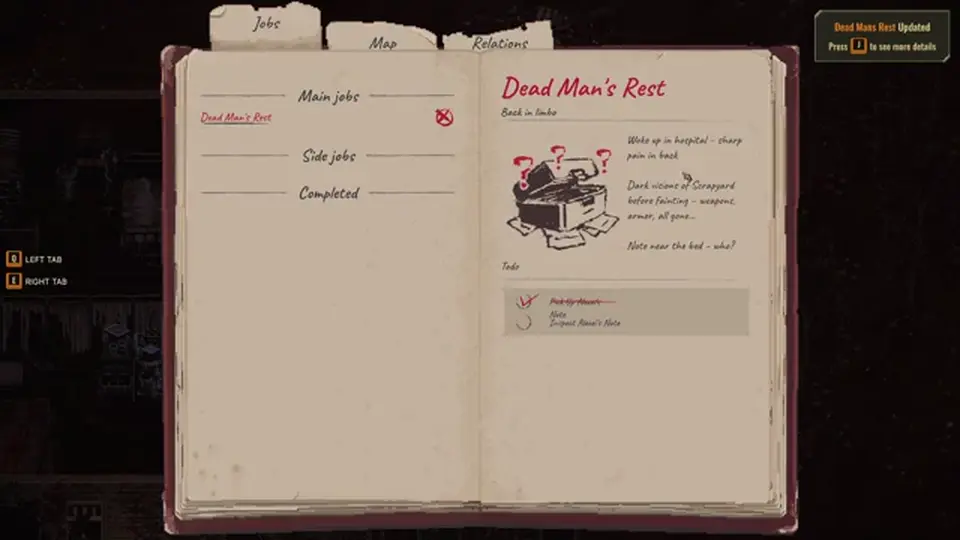
Official EA content includes a journal to track Scavland contracts, main quests, and side quests. Keybinds, tab names, and pin behavior stay TBA. Open it before you leave the safehouse. If a line is a story beat about the East or the RO-29 Highway, that is flavor for map — it is not a reason to skip the job that buys ammo. Main and side quests sit next to contracts in the same tool. Do not assume they share a cooldown.
The journal is the how. This wiki is not a live board. When a patch reworks job icons or types (developer notes mention a job-system rework), recapture the tabs. Until then, believe the screen in your safehouse over a copied list from last week.
Steam lists all three. Scavland contracts are the repeatable work that moves trader standing and pays for the next raid. Main quests are the Act I spine — answers about mysterious soldiers and a land with no Mist. Side quests are everything else the journal bothers to track. Mixing them into one “daily” is how people miss a turn-in. If the UI splits them, keep them split in your head.
A contract item in the backpack is keep-pile loot. See loot. Furniture is not. If the grid is tetris (community), leave a hole for the retrieval before you Shift+Click a toolbox.
A marker on the minimap is a suggestion. Radiation, night, and Mist still tax the walk. Read survival before you treat a journal pin as a taxi. If the pin sits on a hatch, read bunkers — layouts are procedural. Memorizing a “contract bunker map” is a lie you tell yourself after one lucky clear.
Community wiki notes describe a daily 24-hour job pool. That is useful and still wiki, not a Steam spec sheet. We will not print a UTC reset clock. Do not camp a vendor all night because a page said “24h.” Check the live board. If the pool looks stale, leave and raid; if it rolled, pick work that matches today’s kit, not yesterday’s theory.
A job-system rework (icons, new types) is in public development talk. Expect the pool to change shape during Early Access. This page will stay about selection rules: one job, daylight, extract, turn in. Timer worship is how hardcore games farm empty chairs.
Even if twenty lines appear, you have one backpack and one jam-prone gun. Taking three hunts is how Scavland contracts become a death recovery tour. The 24h note, if true in your build, means you can skip a loud line and wait — it does not mean you must clear the board before bed.
Server time, local time, and “it rolled at dawn” anecdotes conflict until we capture a tooltip. Mark every reset claim wiki / TBA. If your session is short, pick a retrieval you can walk in daylight and stop.
Wiki notes name Anatoly and Nadja as contract pools — two boards, not a complete broker census. Treat both names as wiki until the stall UI is captured on this site. They are how some players talk about “whose jobs.” They are not automatically two of the ten factions. Do not invent a third broker to round out a list.
If your journal shows different NPC names, believe the journal. Early Access will rename, merge, or hide pools. The play rule does not care what the broker is called: take work from the stall whose tray you still need.
There is no Anatoly class and no Nadja skill tree. If one pool leans retrievals and the other leans hunts in your build, that is a field observation — log it, do not turn it into a fake meta. First loops still prefer the quieter line regardless of who stamped it.
Official copy: take jobs, complete requests, build reputation. The social step is in the settlement. The tracking step is the journal. Skipping either is how people walk out with no objective and a bag of chairs. Pair with factions so you are not raising a camp you never shop at.
Safer Scavland contracts on a first Act I loop: surface retrievals, settlement errands, and rare-item pickups you can walk in daylight. Loud lines — mutant bounties, human squad hunts, bunker armory clears — wait until you have ammo, oil, and an extract you have already survived once. Read the beginner-guide if you have not extracted yet. The job is not the tutorial.
Rare Item Retrievals (wiki job type) still fail if you fill the slot with junk or die on the walk back. Pack empty grid, a fed gun, and a reason to leave when the HUD yells. Night jobs inherit the flashlight-cone problem from survival. Wait for day if the journal lets you.
| Job shape | First-loop call | Why |
|---|---|---|
| Settlement errand / talk-and-carry | Prefer | Short walk, fewer unknowns |
| Rare Item Retrieval (wiki) | Prefer if daylight and a free slot | Fails if you tetris the item out or die |
| Mutant bounty (Hellhounds / Big Bears / Splatters — wiki) | Defer | Ammo tax, jam risk, incomplete bestiary |
| Human Squad Hunt (wiki) | Defer | Loud; standing and survival both get expensive |
| Bunker / armory clear | Defer | Procedural interior — see bunkers |
| Night-stamped anything | Defer or slow | Cone + A-Life; not a beginner farm |
25+ weapons is a billboard. Your first hours need one firearm that matches found ammo. A bounty that wants a long-range fight is a no if you brought a jam-prone relic. Repair oil is a fight patch, not a personality. If the gun is in the community 50% jam band, do not accept a hunt.
If the pin sits in fog or a swamp, you need the mist kit and a filter, or you need a different line from the pool. Contracts do not grant radiation resist. They grant a reason to walk somewhere stupid. Decline is a valid raid plan.
Wiki mutant bounty names in circulation: Hellhounds, Big Bears, Splatters. Those are examples, not a complete bestiary, and not official Steam creature copy (Steam says mutants, dangerous creatures, A-Life). Do not write HP tables. Do not promise a weak point we have not captured. A bounty is a journal line that asks you to spend ammo you may not have.
Human Squad Hunts (wiki) are people problems: hostile survivors, noise, and possibly a camp you were trying to befriend. They are loud. Pack repair oil if you still take them. Suppression and stealth are official tools — use them to skip a patrol, not to start a neighborhood war. Standing rules live on factions.
You still jam, you still run out of rounds, you still extract overweight. The bounty does not pause A-Life. If a second creature walks in, that is the sim, not a bug. Leave if the magazine math fails. The pool (wiki: 24h) can offer a quieter line later.
Shooting the wrong humans is how dynamic reputation becomes a locked tray. Until we have a verified “this squad is always fair game” flag, treat highway gunfire as expensive. If the journal names a target, shoot the target. If it does not, you are not on a hunt — you are looting with extra steps.
Turn in when the job is done and the kit is worse than when you left — low ammo, oil gone, filter coughing, bag heavy, light failing. Upgrade only happens after Return. A second marker is how Scavland contracts fund a beacon instead of a vendor. If you die, kit a real death recovery or abandon the pin. Do not chain empty sprints with the retrieval still on the corpse.
After turn-in, sell dense junk at the stall you are building, repair, then look at the pool again. That is the same loop as loot and factions, because it is the same game.
The crate behind the bounty corpse is optional. The turn-in is not. Spark plugs will exist in some container on some future day; the journal item on a bunker beacon may not. Procedural rooms will not replay the same closet.
Once the line is in the journal, the walk is a map problem: settlements, swamps, hatch doors, rumor highway. Do not start the walk in Mist because the pin is pretty. Do not start it overweight. Standing waits at the stall. Legs first.
Next: route the accepted marker on the map before you walk.
In-game journal (official: contracts, main quests, side quests). This page is the how, not a live board.
No classes and no skill tree. Gear, standing, and a job you can extract.
Wiki notes a 24-hour job pool. Recapture the clock. Check the vendor, not this page’s watch.
Wiki-named contract pools. Confirm on the live board. They are not a complete broker list and not automatically two of the ten factions.
Wiki bounty examples, not a complete bestiary. Steam’s public creature copy is broader (mutants, dangerous creatures).
No. Surface retrievals and settlement errands first. Procedural bunkers are a different product.
Matched by build plan, shared topics, and guide progression — not random related links.